Furniture guide · Sofa construction
A Sofa’s Hidden Structure: How Frame, Springs, and Cushion Fill Shape Comfort
A sofa is a small landscape of hidden forces. Beneath the fabric, a frame holds the shape, a suspension system carries the weight, and cushions distribute pressure across the body. Those unseen parts influence whether a seat feels buoyant or yielding, stays steady through years of use, and suits the everyday rhythms of a room.
Published October 21, 2026
At first glance, choosing a sofa seems like a matter of silhouette, color, and proportion. Yet upholstery is only the visible surface of a more complex object. Every time someone sits, leans back, stretches out, or shifts position, the sofa transfers weight through a chain of components. The frame resists movement. The suspension flexes and rebounds. The cushions compress, then recover—or, eventually, do not.
Understanding that chain makes it easier to evaluate furniture beyond appearance. It also helps explain why two sofas with similar outlines can feel quite different, and why a beautifully upholstered seat may still disappoint if its underlying support is poorly matched to the household. Comfort is not one material or measurement. It is the outcome of several parts working together.
This guide examines the essentials: frame materials and joinery, suspension systems, and cushion fills. It offers questions to ask when comparing sofas and practical ways to connect construction details with real-life needs, from frequent lounging to occasional entertaining and the constraints of a compact floor plan.
The frame: a sofa’s quiet skeleton
The frame is the structure to which the seat, back, arms, and legs are attached. It must hold its geometry while bearing repeated loads, including the uneven ones that come from a person dropping into a corner or sitting on the edge. A stable frame can help a sofa feel composed; a weak or poorly assembled one may creak, rack from side to side, or loosen at its joints.
Hardwood is a broad category rather than a guarantee of quality. Species, drying, thickness, design, and workmanship all matter. Kiln-dried lumber has had moisture reduced in a controlled process, which can limit the movement that may occur as wood adjusts to indoor conditions. That does not make every kiln-dried frame identical, but it is a useful construction detail to ask about.
Engineered wood products, including plywood, can also be used in furniture frames. Their performance depends on grade, thickness, placement, and how components are joined. A carefully designed frame may use different materials in different areas, reserving stronger members for high-stress zones. A label naming a material alone cannot reveal the whole story; the construction plan and the quality of assembly count as much as the raw ingredient.
Joinery is where frame members meet. Reinforced corner blocks, dowels, screws, and well-fitted joints can help distribute forces across the structure. Staples or glue may play a role in assembly, but they should not be mistaken for a complete description of how the frame is built. If a retailer can explain how the corners are reinforced and what warranty applies to the frame, those answers offer more useful context than a vague promise of durability.
Some sofas are built with frames designed to be lighter or more flexible; others prioritize a substantial, rigid structure. Weight may offer a clue, but it is not a verdict. A heavy sofa could owe its mass to many components, while a well-engineered design may use a more efficient structure. Consider how the piece will behave in the room: Will it be moved often? Must it fit through a narrow stairwell? Does it need to sit securely on a smooth floor? These practical questions make frame construction part of space planning, not just a technical footnote.
Joinery and movement: stability in a lived-in room
A sofa is not a static object. It shifts slightly under changing loads, and its feet meet a floor that may not be perfectly level. Over time, repeated movement can test joints and connections. A sturdy frame should feel settled when someone sits down, rather than wobbling or twisting under ordinary use.
When possible, assess the sofa in person. Sit in more than one position, then pay attention to the whole piece: Does the frame make a noise? Do the arms feel secure when lightly pressed? Does the seat stay level, and does the sofa move unexpectedly? A showroom test cannot predict every year of use, but it can reveal obvious instability and give you a better sense of construction.
Ask about repairability as well. Removable legs, accessible upholstery panels, replaceable cushions, and available service information can make maintenance easier. A sofa designed to be repaired may remain useful longer than one whose components are difficult to reach. The answer depends on the model, so request specifics instead of assuming that a particular frame material guarantees a long service life.
Suspension: the bridge between frame and seat
Between the frame and the seat cushions lies the suspension system. It supports the cushions and helps determine how weight is distributed. This layer is easy to overlook because it is usually concealed, but it plays a major role in how a sofa responds when someone sits down.
One common approach uses sinuous springs: bent steel wires arranged in repeated curves and attached across the seat frame. Their performance depends on wire gauge, spacing, attachment, and the overall design. A well-made system can provide responsive support in a relatively shallow space. If the springs are widely spaced or poorly secured, the seat may feel less even, though cushion design also affects the impression.
Another approach uses webbing—strong woven straps fixed across the frame. Webbing varies by material, width, tension, and arrangement. It can produce a more flexible or elastic feel, depending on the specification. The word “webbing” by itself tells little about how supportive a sofa will be; ask what type is used and whether the manufacturer describes a recommended maintenance or repair process.
Some traditional designs use coil springs, including units with individually wrapped or interconnected coils. Their feel and durability depend on the spring arrangement and the layers above them. A spring system is not automatically superior simply because it sounds substantial. The useful question is whether the suspension suits the seat’s dimensions, cushion construction, and intended use.
Suspension and cushions must be considered together. A taut support system under a firm foam cushion can feel very different from the same system beneath a soft, fiber-filled cushion. Likewise, a generously padded seat cannot compensate indefinitely for a failing suspension beneath it. When comparing furniture, ask about both layers and, where possible, test the seat with the cushions in place.
The term “soft-edge” appears in some sofa specifications to describe a support construction. Its exact meaning can vary by maker, so it is worth asking for a plain-language explanation rather than assuming it refers to a particular spring type. Product details for the Cisco Home Hayden Deluxe Sofa, for example, identify an FSC-certified hardwood frame and soft-edge support. Those details are a starting point for a construction conversation, not a substitute for evaluating the sofa’s feel and fit in person.
Cushion fill: the feel you notice first
Cushions are the part of a sofa that most directly meets the body. Their fill determines how far a person settles into the seat, how quickly it responds to movement, and how much regular attention it may need. The cover and internal construction matter too: fabric tension, seams, cushion shape, and the distribution of fill all influence the finished feel.
Foam is commonly used in seat cushions. Its firmness and resilience vary with formulation and density, and these terms are not interchangeable. Firmness describes the initial sensation when pressure is applied; density relates to the amount of material in a given volume and can be relevant to durability. A dense foam is not necessarily firm, and a firm cushion is not necessarily the best choice for every person. Ask for the maker’s specifications and sit long enough to judge whether the seat supports you comfortably.
Fiber fill, often made from polyester, can create a soft, light feel. It may be used alone or as a wrap around a foam core. Fiber tends to shift and compress with use, so cushions may need regular plumping or rotation to keep their shape. That upkeep is not necessarily a flaw: it is part of the care routine that suits a softer, more relaxed seat.
Down and feather blends can offer a plush, yielding sensation, often with a foam core for added structure. They usually require fluffing to restore loft and redistribute material. People who prefer a seat that feels crisp and holds a defined outline may find this maintenance less appealing; those who value a softer, sink-in quality may consider it worthwhile. Always check the fill composition and care instructions, including any considerations related to allergies.
Many cushions combine materials to balance support and softness. A foam core wrapped in fiber or down, for instance, can feel more cushioned than foam alone while retaining some structure. Even within one category, formulas and proportions differ. Ask whether seat and back cushions use the same fill; backs are often designed to feel softer than seats because they support the torso differently.
Seat shape affects maintenance, too. Separate cushions can often be rotated or swapped to spread wear, depending on their design. A single bench cushion creates a continuous visual line but may concentrate use in favored seating spots. A tufted back or fixed cushion may keep its intended outline while offering fewer options for rearranging its internal fill. These are not universal advantages or disadvantages—just trade-offs to weigh against your habits.
The Cisco Home Kenso Sofa illustrates why cushion configuration is worth noting: its listed design includes a single bench seat and a tufted back. The specification describes an FSC-certified hardwood frame and soft-edge support, but does not state the cushion fill. If evaluating a particular sofa, treat that missing information as a useful question for the maker rather than trying to infer the material from the silhouette.
How construction shapes comfort over time
On the first sit, softness may dominate the impression. Over months and years, other qualities become clearer: whether the seat recovers its shape, whether the support stays even, whether cushions migrate, and whether joints remain quiet. This is why a quick showroom test should be paired with questions about care and construction.
Think of comfort as a relationship between the sofa and its user. Seat depth affects whether feet rest comfortably on the floor or whether a person prefers to tuck their legs beneath them. Seat height influences how easily someone can rise. Back height and cushion firmness affect posture and lounging style. No single combination works for every body or activity, so “comfortable” is best defined through the routines the sofa must support.
Household patterns are informative. A seat used for daily television, reading, naps, and family gatherings experiences different demands from one used mainly for conversation. Children, pets, frequent guests, and people who prefer to eat on the sofa may all affect the ideal cover, cushion design, and maintenance plan. Construction cannot eliminate wear, but thoughtful selection can make the expected wear easier to manage.
Reversible cushions can extend the usefulness of upholstery by allowing the surfaces to share wear, if the design permits flipping. Removable covers may simplify cleaning, but washability should never be assumed. Fabric care depends on the specific fiber, finish, and construction; follow the manufacturer’s directions. A sofa with fixed upholstery may still be a suitable choice, but it calls for a care routine aligned with that limitation.
A practical checklist before choosing
Specifications are most helpful when translated into everyday questions. Use this checklist to compare models without getting lost in unfamiliar terms:
- Frame: What materials are used, and how are the joints reinforced?
- Support: Is the seat supported by springs, webbing, or another system? Can the maker explain what “soft-edge” or similar terms mean in this model?
- Cushion fill: What materials are in the seat and back cushions, and how do they differ?
- Care: Do cushions need regular fluffing or rotation? Are covers removable, and what cleaning methods are approved?
- Dimensions: Are seat height, depth, and arm height comfortable for the people who will use the sofa most?
- Room access: Will the sofa fit through doors, corridors, stairs, and elevators? Can the legs be removed if needed?
- Service: What warranty applies to the frame, suspension, and cushions? Are replacement cushions or repairs available?
- Use: Does the construction suit the household’s daily routines, rather than only the room’s appearance?
When testing a sofa, spend more than a few seconds on it. Sit upright, lean back, and try the posture you use at home. If several people will share it, invite them to test it too. Notice whether the edge feels supportive, whether the back meets you at a comfortable height, and whether the arms are useful for resting against. Bring measurements of the room and, if relevant, the entry route; a sofa that cannot reach its intended place is an expensive architectural puzzle.
The sofa as part of the room
A sofa’s structure also influences how it behaves within a floor plan. A deeper model can invite sprawling but occupy more circulation space. A tall, weighty frame may anchor a broad room, while a slimmer profile can preserve openness in a smaller one. Moving a sofa may be easier when legs are removable, but that feature should be checked in the specifications rather than presumed.
Consider the space around the sofa as carefully as the footprint beneath it. Walkways should remain clear, tables should be reachable, and seats should face one another or a focal point in a way that supports conversation. The best frame, suspension, and cushion fill cannot rescue a layout that obstructs movement. Conversely, a thoughtful arrangement can make a practical, unshowy sofa feel entirely at home.
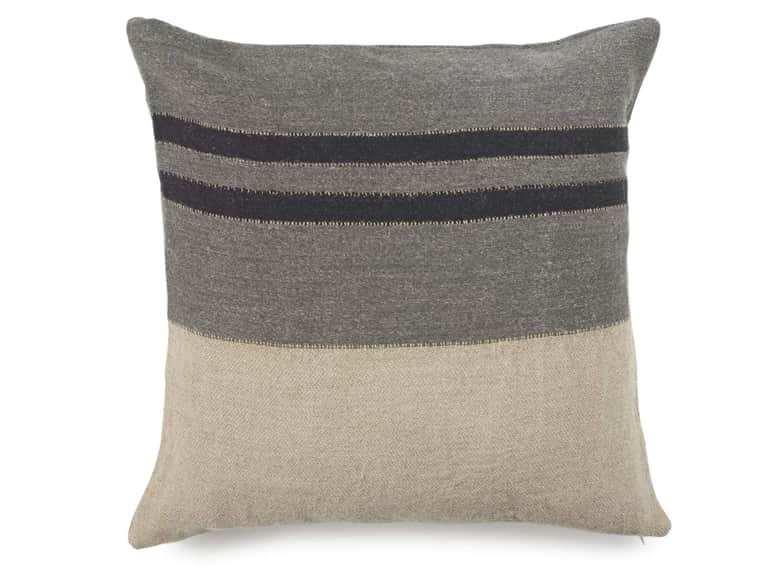
Materials contribute to a room’s atmosphere, too. A substantial frame hidden beneath tailored upholstery may offer a crisp, architectural presence; relaxed cushions and textured fabric can soften that outline. A natural-fiber accent, such as a linen-and-wool pillow cover, can introduce tactile contrast without changing the underlying seating support. But decorative layers should not be confused with structural comfort: a cushion added for styling may improve the feel of a backrest, while the sofa’s own seat system still does the essential work.
A better way to read the label
Furniture descriptions often present construction as a list of materials. A more useful reading connects each material to a function. Hardwood and joinery describe the structure. Springs or webbing indicate how the seat is supported. Cushion fill describes the immediate contact and recovery. Upholstery affects touch, appearance, and care. Dimensions translate those choices into the body and the room.
Look for precise information, but recognize what a specification cannot tell you. A material name does not reveal every detail of workmanship. A supportive description does not replace sitting on the piece. A warranty offers some protection but is not a promise that no maintenance will ever be needed. Confidence comes from combining the written details with direct testing and a clear understanding of how the sofa will be used.
In a well-considered sofa, the visible form and hidden structure are partners. A frame provides the stable outline; the suspension carries and redistributes weight; the cushion fill shapes the sensation of settling in. When these elements suit one another—and suit the people, room, and routines around them—the result is more than a handsome object. It is a dependable place to pause, gather, read, and return to, day after day.